Powered By Blogger
Showing posts with label entrepreneurship. Show all posts

Saturday, November 1, 2014

What is Preventing Indians From Shying Away from the Great Opportunities of Corporate Entrepreneurship?

India is a vibrant nation of youths aspiring for getting some job. Unemployment is a serious problem. Millions of youths who graduate from the higher education and professional institutions in the country are finding it difficult for getting some job of their liking in the organized sector. Many are underemployed or are compelled to work in the unorganized sector for a livelihood.

At the same time, India is a land of great opportunities. It geography, population and scope for development give immense opportunities for business. In essence the potentials for entrepreneurs desiring to take up the initiatives are immense.

The problem lies with the Indian educational system. The conventional education system of the country provide little information to the students about the essentials of doing business. Business knowledge and skills have always been a matter of confidential knowledge held by those who either inherited it or tried hard to acquire it under compulsions or by chance.

The hundreds of business schools in India hardly impart any meaningful knowledge to their students in the fundamental aspects of setting up a business entity. While the business schools impart theoretical knowledge in management principles, they never try to go beyond it to equip them in the real practical knowledge that is essential for any business entrepreneur to confidently proceed to make his business ideas work.

Often the educational curricula are made by academicians who have no real experience in business or industry. Industry-business-academic cooperation and interaction in India is a much talked about subject with no one ever trying to do any thing to achieve it practically. Indian academicians clandestinely do all they could to protect their interests always. As is usual with any other profession, they too are too protective about their jobs and would not allow others to enter in to their profession. As a result, there are only few industry experienced persons in the academic councils, senates and syndicates of the Indian universities. As such, the universities and autonomous colleges, including the engineering and management institutions of India fail miserably to absorb the industrial and business experience and knowledge to the their students.

The end result is a large workforce who lack essential knowledge and confidence to undertake challenging jobs and assignments. Excepting a few of the self driven types, the rest miserably lack the skills required for meaningful employment or entrepreneurial qualities for venturing in to the setting up of business ventures of their own.

India may be finding a few young and successful entrepreneurs here and there. But they have mostly got their entrepreneurial skills and abilities by self actuation and abilities and not by the specific grooming they received through their respective educational institutions!

The Indian parents mostly are pessimists with regard to their wards venturing in to any business. Excepting those few business oriented families, most of the common folks discourage their young ones from trying any business of their own. A good majority of middle class parents also consider many kinds of business as some kind of taboos or not befitting for their family status. Many housewives in India are too uncomfortable about the thoughts of any of their family members going ahead with some business ideas. Lack of support and opposition from the family women folk drives away the little enthusiasm that might be with those few with some entrepreneurial ideas!

The Indian middle class are too obsessed with the idea of sending their wards to foreign countries such as the USA, UK, Middle East, Canada, Australia, etc rather than they try their fortunes in their own nation. 

As a result, premier engineering institutes such as the Indian Institutes of Technologies (IITs) have become mere training grounds for foreign job aspirants! There may be only a few IITians who could successfully streamline their acquired skills and inherent intelligence to establish themselves as first line indigenous entrepreneurs!

All these have happened due to the wholly defective policies of the Indian government that has been in vogue for the past many decades. The Indian governments of the past hardly encouraged first hand business entrepreneurs unless they are some cronies connected to those in power! The Indian bureaucracy too has ensured that the rules and regulations made by them and approved by their political masters so far are solely for ensuring their controls over the business community. 

In such a scenario, no business man could possibly survive in India without bowing their heads before the bureaucrats! The bureaucrats usually get the laws and the regulations drafted and approved by their political supremos giving much leverage for themselves. This necessitates scores of governmental approvals to start any business. Obviously, such approvals do not come forward so easily unless the potential business promoter is willing to spend and bend! At least that is what the common perception in India has come to mature!

Fortunately, the information technology has helped to break many of the bureaucratic and political interference in many kinds of business in India. IT has enabled higher transparency in the governmental procedures to some extent. It is also enabling dissemination of knowledge and breaking the monopoly of formal education system. A positive development indeed!

Successful Indian businessmen, barring a few, are those who have come up under severe constraints facing many problems. Hence they attribute their success to gods and luck rather than their knowledge and hard work. As a matter of fact, many of the existing successful business people do not possess any expert knowledge in the fields of business where they prospered. Their essential knowledge has been in the manipulation of money and people with the help of intelligent but slavish employees!

Many of the Indian businessmen are too scared to reveal their success stories or to encourage young India to venture in to business. Many of them are also too greedy that they would not like a share of their huge profits to be distributed among their employees and clients or even with the nation! They are too apprehensive to be honest due to the prevailing business atmosphere. They know that the country as a whole is not going to honor their contributions. Why should they do things honestly when they are deemed as thieves of the national wealth? There is an immediate need for changing this common belief. There is an urgent need to honor and respect practically honest businessmen and women who create more employment opportunities rather than big market capitalization!

Businessmen who generate thousands of jobs should be honored as national heroes. We can take a lesson from China where Jack Ma has got that preference from the Chinese government because he has been successful in generating millions of jobs! Compare that with the story of Subrata Roy of Sahara in India! 

I earnestly hope that many of our young people would shed their inhibitions and begin exploring the possibilities of becoming job creators rather than job hunters. The formal education system of India may not be in a position to help them for the time being. But the informal internet knowledge base could be easily explored for all necessary guidance for those willing to learn and act.

Business is not about becoming Jack Ma or Dhirubai Ambani overnight. Business is also not to be considered as an option viable only in the urban areas. It is also not a fact that all business start ups need huge investments. In India, there exist good opportunities for small and medium corporate model businesses for the rural areas with low investments. Why can't we think of having corporate offices in the rural areas and tap the talent pool of the rural areas? Why do we need to make a situation that results in the flow of people to the urban areas? Indian metros are already starving for resources and infrastructure. The present flow of population from villages to cities is due to the apparent notion of the people about the job potential of the cities erroneously conceived by wrong policies and feed backs!

In India, the term business brings the image of a petty retailer's face or a well known business tycoon's face in the minds of the ordinary folks. Both do not reflect the true reality. Business and entrepreneurship are something in between the two and have much more potentials than commonly understood!

What are the essential things for doing any business in India?

Young entrepreneurs need to know the basics of the laws that govern the business. They need to know the basic rules of the game. They should also know the great potentials of doing business under the corporate banner rather than doing it as proprietary or as a partnership. They should know the essentials of corporate management and capital raising. Such knowledge would help them to propel their business ideas to get matured and implemented.

Profit alone should not be the motive for business for the young Indian entrepreneurs. They should think of such businesses that would be a useful help to their customers and clients. They should learn to do business without cheating or without breaking the laws. They should device their companies which gives a win-win platform for all the stake holders-to themselves, their share holders, their clients, the government and the general public. They should not allow their companies to be operated under the motives of greed. When this becomes the fundamental guiding principle, there is absolutely no reason that their venture would not succeed! 

How to know the essentials of setting up a business in India?

The following are some links that give much information for those who are desirous of becoming corporate entrepreneurs rather than mere job seekers: 

1. The official business portal of India

2. The online business guidance portal startbizindia

3. Steps for New Company Registration: India

4. How stocks and stock markets work?

5. Indiafilings- Online assistance provider for starting business

Wake up and act. Let us do things in India and prove the might of our nation!

Best wishes to all potential businessmen and women of India! May your efforts bring prosperity!

Thursday, October 30, 2014

Some Hard to Believe Truths About the Children Who Occupied the First and Last Benches in Schools!

Today morning a cousin shared a truth that he or some one else like him might have experienced in life through the latest real time messaging application now familiar to all as WhatsApp : The message read like this:

"First bench doing job and last bench doing business. Truth of school life. A first bench student knows the answer to every question (problem), but the last bench student knows how to face every problem!"

Yes, there are enough examples that you could find to prove that this is true.

I too am too tempted to agree with this statement wholly and wholeheartedly.

During my school days, I have been more-or-less one of the first type who sat on the first bench mostly always. We were the so-called class toppers who were the pampered best students of the teachers. We were often the role models our teachers pointed to our not-so-fortunate back bench sitters. We hardly got an opportunity to notice the faces of those sat behind us in the back benches. The last bench ones were not the favorites of the teachers, but they were no doubt our heroes! Because, they were good at many things that we could hardly think of accomplishing in those days, other than perhaps scoring the marks in the test papers.

Rose Garden in a Private Suburban Indian School Campus!
Thrust Mainly towards Screening High Scoring First Bench Sitters and
Weeding Out the Low Performing Last Bench Sitters!

Perhaps, that could be one reason that I tried to change my image during my senior days with a bit success. In fact that helped me to experience the advantages of both to some extent!

But being nurtured for the first bench, I was bound to become a servant or naukar doing service or naukari and I became an accomplished naukar among the vast group of such naukars all around. But with my bits and pieces of last bench experiences, I could no doubt notice the poor slavish state of minds that my colleagues mostly possessed with little scope for trying out any new things even if it could make their own lives much better.

They were not trained to face challenges. They have been trained to follow the established legacy of work culture as per instructions only! Most of our bosses too were not much different, because they too were only naukars with a little bit more accomplishments than the rest of us!

Many of us, during the course of our naukari acted the double role of dogs and gods! We understood nothing more than that, to be very frank. We kept remembering our school teachers and our over ambitious parents who either patted or scolded us for keeping us the disciplined children who never ever ventured to question the established ways of knowledge and culture.

In India, our colonial masters needed literate servants in limited numbers and hence the schools that produced such servants were much less in number during the formative years of young nation. But later, the demand rose and we created more and more such schools and educational institutions that continued with the same methodology of teaching and training!

So we had only teaching and training institutions catering only those in the front benches. We cared little for the back and last bench ones. But fortunately, among them were the ones who did not need any formal teaching and training. Among them were the few borne leaders who mastered the skills to face problems instead of selecting stereotyped answers to problems!

I had been an admirer of those who sat in the back benches. Some of them could turn their initial misfortunes to great fortunes in later years. How can I forget the back bench heroes of our times?

Dhirubai Ambani, Bill Gates, Jack Ma etc lead the long list. On the other hand, we the disciplined and well liked ones who occupied the first benches kept doing our servant roles receiving the ten chakrams of Padmanabhadasa. 

I am not telling that servants like us are not required. We are indeed the work force who are doing the jobs. All kinds of jobs!

But regrettably, we are more in numbers than the job opportunities for us to act. We do not know how to create jobs. We only know how to do the jobs that are demanded from us. When we are in great numbers than the job opportunities, the demand for us goes down and as a result our value too!

So those of us of the first bench sitters either struggle to get jobs or struggle to get more value for our jobs.

But the few who sat behind us face our problems differently in a way that we never understood in the beginning until they told us the details. And we find them making value and wealth in such a manner we never could understand well.

So they keep staying as our heroes. We envy them  and secretly tell all bad things about them out of our envies.

But we need more of them for us to think and act differently. We need more of them to lead us. Without them we cannot do our service! We need them to tell us what to do! They are our entrepreneurs and business men. They are the job creators. They are the ones who find ways of creating wealth and enabling us to work! We need them in right proportions among us. Those naturally getting developed by sitting in the back benches are not enough. We really need more of them.

But how can we possibly make more of them? Can any of us of us of the first bench type be made to be like them? What should we do in our schools?

Any ideas ?

Wednesday, September 24, 2014

Why Do Malayalees Keep Preferring Padmanabha Dasa's Ten Chakrams?

Yesterday evening while having a usual pleasantry talk between me and my daughter over the cell phone, the issue of school admission for my grand daughter got in to our talks. And that initiated a kind of debate between us which soon was progressing towards an agitated argument that I skillfully put an end to our talks and said good night to her.

My book has taught me why I should not argue more to prove my point lest the truth what I want to convey becomes degraded to the status of an untruth.


Before I go further, it would be prudent to give some background of the issue with my readers.

My daughter, her husband and their five year old child are now in New Delhi. My daughter, who is an MBA had been working as an executive for the past few years before she finally decided to become a housewife to look after her child. Ever since, her most important passion and devotion in life is the upbringing of her child. She would go to any extent to accomplish that, just as any other urbanized middle class Indians. She and her husband want their child to get the best possible education. The only difficulty, as I see it, is their lack of clarity with regard to what they consider as the best education! No doubt, here too, they are no exceptions. The majority of urban or suburban middle class Indian parents now possess this mindset which is the bane of the Indian society, in my humble opinion. They are too willing to be exploited by the clever education entrepreneurs and so-called educationists of India who keep subverting the age old system of education for their own benefits. The aspiration for giving the child the best education is no sin. The definition of 'best education' is the real problem!

So, they have already spend a good fortune to get their child admitted in to one public school in the national capital region in the nursery level. Like all others like them, they have been now brainwashed to believe that spending on education for their child is the best thing that they can do for their child.

The Impressive Gates of a Typical 
Saintly Public School in India 

So, if the schools harass them, they are not much perturbed or they tolerate that without any complaints. 

If the schools charge 150,000 for a nursery level admission, they do not feel it as an exploitation! 

After all how can the schools give good and elite education if they charge only peanuts as fees? They argue! 

They are not disturbed and overtaxed when these schools burden them with heavy home works for the parents (mostly to be taken by the mothers!) and the kids, whose brains and bodies are just in the initial stages of development. For that matter, I have heard about other over enthusiastic young parents (again, mostly the young mothers!) who are too willing to get in to a cesarean to be performed on them to get the child delivered at the most appropriate zodiac time in the hope that their child would become a super human genius at some later stage!

My daughter fortunately understood these things very well. But her problem was the lack of mental strength to resist such evils that are slowly destroying the society in the ways that are never discernible to most of such parents. How could she be the odd woman when the whole society moves in one direction?

Now her worries and anxieties are mounting as her husband has determined to move to Chennai from Delhi to take up a better career there. But the Chennai school authorities are no saints any more. They would not even talk to them unless they are prepared to shell out a huge fortune to get her child a primary class one admission there. The schools bearing the names of the Christian saints are in the forefront now to prove the real meaning of sainthood to all those saint seeking people of India! And saintly schools have mushroomed in large numbers in all nooks and corners of India in the recent times with more and more people are willing to get their children educated there at whatever costs!

I told her to read this recent article that has come in the Outlook magazine online edition recently where the learned author has worked out the present value of the cost of educating your child in India now. 

The author has worked it out at Rs. 42 million for an average education spanning about 22 years in any average saintly schools or similar followed by any average kind of private engineering and management institutes of India. 

If this sum is handed over to the young man or lady after 22 years as a fixed deposit in the bank, it would fetch the young one an interest of nearly Rs.300,000 ($ 5000/-) per month. That is the average annual salary now for any fresh MBA in India who is fortunate to get a job!

If the child is allowed to study in the most humble and inexpensive government owned education system, not only this money would come handy, but also the child would learn things in the most realistic manner that would enable him or her to take up real challenges of life in a better way, the author argues. 

I agree with him fully, because I myself have undergone such an education system and it has given me the outstanding capabilities that I consider as my strength. There were a few among my time who had gone through the so-called elite public school education system imitating the Doon School or other such schools which existed as elite schools in India during the British Raj. No doubt, some of their alumni  have matured up as elitists who are generally considered as having good education. Perhaps they have been good in reciting Shakespearean poetry and might have climbed up the success ladders of professional career due to their better accessibility to receive favors and their connections! But many of them do lack common sense and the real human understanding of life gained from real human experiences!

But my daughter would not agree with me. Neither do any one like her. My children would also not agree the way I myself proceeded to educate them. I stuck to my convictions to the extent possible. I have been always against mushrooming elitist public schools  which I firmly believed as agents that destroyed the social fabric of the Indian society in a subtle manner. These schools caused many children to get developed as individuals with some robotic characteristics, eliminating their natural instincts of creativity and free thoughts!

I am not against private unaided schools or unaided educational institutions with good infrastructural facilities. But education as it stands today is a declared non-profit service in India. And if it is so, it has to remain that way in practice as well. It should not become a clandestine exploitation service for the ignorant society at large!

It should be a mandatory requirement for all educational institutions to publish their income expenditure statements and they should not be allowed to accumulate and divert their excess incomes. They should prove that they are non-profit organizations in practice, if they are registered under that non-profit society umbrella.

On the other hands, the government should allow education entrepreneurs to set up education shops for profit for satisfying the rich and the elites in the society. Let them take any amount of fees that their clients can afford to pay. But it should be a declared policy and not a clandestine arrangement. 

The problem now is of hoodwinking. Some educational institutions hoodwink the gullible parents to believe that they provide the elitist education for ensuring sure shot success of their children. The gullible middle class are forced to believe that the success of the elitist children with parental clicks and connections are the real educational contributions of these so called institutions. Many such institutions are functioning in India in the name of saints and gods, declared as charitable or religious organizations for educational service without any profit making desires whatsoever. But as of now, the reality is some thing very different!

To prove that their education is the best, these educational institutions adopt all kinds of tricks in their arsenal. First they screen the children and the parents in the name of various admission tests. 

They achieve a two fold gain in this process. Firstly, they get the children of better IQs or children of over ambitious parents who are too willing to do any thing to get good marks for their children. Secondly, this ensures better results in the examinations that is the net result of the parents' hard work and the children's better IQ. In this process they screen out all children with any perceivable lack of privileges and showcase the better results as their own achievement. This in turn  ensures a steady stream of parents flocking to such institutions year after year, boosting their financials.

Now what happens in this process? All underprivileged children (underprivileged physically, financially or socially) are naturally denied the opportunity of any reasonable education due to the eagerness of the such schools (read the individuals who manage them!) to maintain their market value. The eagerness in making market value naturally involves creating artificial problems in admissions and troubling the young parents in many ways.

The principals of these kinds of schools have become management agents and not any real and respectable teachers. The teachers have become exploited and overworked individuals who no more have the capacity and ability to be termed as teachers in the real sense! They have downgraded themselves to the status of 'education employees' (शिक्षा कर्मी ) instead of becoming the real and respectable gurus or master guides to their children.

There could be exceptions here and there. But in general, things are moving in a direction that is causing a fast deterioration of the status of the teachers, both in the private and in the government funded institutions, for different reasons!

And what is the final outcome? The inherently good students get screened to be exported to foreign countries to become a generation of second class citizens there in the coming future. Another lot becomes improperly educated ones with distorted moral values to become slavish future citizens of India with no enthusiasm for entrepreneurship. Again, you should excuse me for the generalization!

The majority parents want their grown up children to become employees in some foreign nations or of the government or some other public organizations.  

Middle class parents of India normally do not encourage their children to become self employed or to become entrepreneurs. They want them to become salaried persons of any company or the government at any cost. They are not willing to take any lessons from the successful businessmen and women of India who in the recent past have become successful wealth creators and employment creators. Excepting some, a good majority try to kill any such aspirations of their children! And the Indian education system does not help to improve this mindset of the people in any way.

And job generation is a big problem for a country full of average and non-enterprising minds! The number of employment creators keeps reducing with this kind of a scenario that prevails in India now! India does have immense potentials for employment creation. But the non-enterprising minds of the people do not allow it to happen. The governmental attitudes also create much difficulty.

In my home state Kerala, getting a job of the government (सरकारी नौकरी ) of the king was once upon a time considered as the biggest achievement of any person. The erstwhile kings of Travancore kingdom had the title Padmanabhadasa (പത്മനാഭ ദാസന്‍) . The travancore currency used to the rupee with the chakrams (ചക്രം) and Kashu ( കാശ്) as the coins. A government servant getting ten chakrams monthly was considered as having a higher status in the society and was commonly titled as : Padmanabha dasante patthu chakram pattunnavan. (പത്മനാഭ ദാസന്റെ പത്തു ചക്രം പറ്റുന്നവന്‍) which literally meant the person drawing ten chakrams from the king's treasury in a month as salary. Such a person was given a higher status in society than a trader or farmer who made ten times or more that amount in a month! This was because the government servant, though having a lower income, was having a higher level of education than his money making fellows in general in the past. The respect came from the educational status and not from the wealth status. This was indeed a good thing initially which enhanced the aspiration for education among the people. But the difficulty arose with the people refusing to change with the times!

In reality, this mind set is not limited to the Kerala people alone, but is more or less common with most of the middle class people of many Indian states. Punjab, Haryana, Gujarat and Tamil Nadu could be some exceptions! 

Besides, this mindset caused another problem. The Indian people-the majority of them- are not prepared to honor a person who makes a decent living by self employment or by business. A person who has become successful in business secretly becomes one envied and the envy often got expressed in private by the people calling him some words which meant illiterate fool (अन पढ़ गवार)! Naukary ( नौकरी) or employment and a monthly salary continued as a status symbol among the middle class people of India even now. The status as a salaried employee is perceived as less risky and easy even when the situation has changed much from the olden days!

In such a situation, education has been considered as a tool not for gaining knowledge and culture, but a passport for getting a monthly salary earning employment! 

The educational degree certificates became more important than what has been actually learnt! When the degrees became more and more accessible, people began to look for educational certificates that have some exclusivity in them that could give them some additional status value!

The Indian education system has done hardly anything to change the mindset of the Indian people. On the other hand it has been doing  much to enhance this mindset in the Indian people.

And this is the real curse of the Indian society. If India is not making progress in all fronts simultaneously, it is because of its faulty education system. 

India needs an education system that does not cause further divisions in the already divided society on the basis of education based on any pseudo status. There should be a social awareness campaign that would break the false thoughts of the people and encourage them to view all educational institutions equally. All media efforts to promote some educational institutions as the best or having some higher rating should be shunned while constant efforts are done to improve the standards of all educational institutions and schools on a consistent manner.

Parents having the strength of mind and will power should come forward to promote the government run schools and institutions by sending their wards to such schools and institutions as far as possible.

The unholy alliance between some private companies and some professional institutions in selection and recruitment should stop.

Last but not the least, the educational expenses in the country should be brought under control by decisive actions. No educational institute or school declared as non-profit institutions should be allowed to charge unjustified fees that are not affordable to the average Indian.

The government should maintain subsidized education to the meritorious students who study in the government run institutions such as the IITs, NITs and the IIMs. There is no justification for them to charge hefty fees like the private institutions. 

Organizations should be encouraged to sponsor meritorious students with employment guarantees or with merit cum means scholarships.

All professional institutes or the government should give the data regarding the percentage of people who are employed out of the total pass outs so that the parents could take well informed decisions on spending money and time for any particular professional course. 

As land is becoming scarce to open future educational institutions, government should encourage opening large fully residential campuses in remote rural areas instead of allowing them to be opened in urban areas. The best successful example in India in this regard is the Lovely Professional University in Punjab state.

While higher educational facilities have improved much, the school education system has not. It is indeed a pathetic sight with our tiny ones and their guardians taking all the toils in the name of education. We need to learn much from the developed nations.

That is my perception, whether you agree or not. 

But I do welcome your views both in support and against.

Saturday, September 20, 2014

Kerala House Boat Tourism and Some Thoughts Arising From It!

A speeding House Boat in the Vembanad Lake of Alleppey

I was very delighted to see a small news clip in a Malayalam TV channel yesterday about the inauguration of an internet portal that provided travel enthusiasts the much needed information about the Kerala luxury house boats.
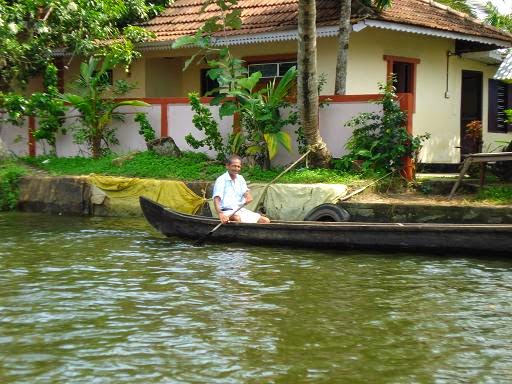
A small wooden boat in the approach channel 
to Vembanad Lake at Alleppey
This new online Kerala House Boat information and booking website which came into official existence is www.myboattrip.com which is a safe and secure website.

 
An Alleppey House Boat
The ever shining Malayalam actor Mohanlal [മോഹന്‍ലാല്‍] reportedly inaugurated this website which is an initiative by M/s Safe Boat Trip Private Limited of Kerala.

A House Boat in the Backwaters of Kerala
The house boat tourism began in the back waters of Kerala a couple of decades ago in a big way when an enterprising Kerala businessman built the first luxury houseboat for tourism purposes, spending millions. But houseboats called kettuvallam (കെട്ടുവള്ളം) have been in existence in Kerala rivers and backwaters perhaps for centuries. They have been used for days long journeys through the calm backwaters and rivers of Kerala. I remember enjoying a lunch inside a kettuvallam during my early childhood days. It was owned by some of our relatives who lived in the water locked Kuttanad area who came all the way travelling through the Pamba river to attend the famous Christian annual convention called the Maramon Convention. That was some time in the Nineteen Sixties. 
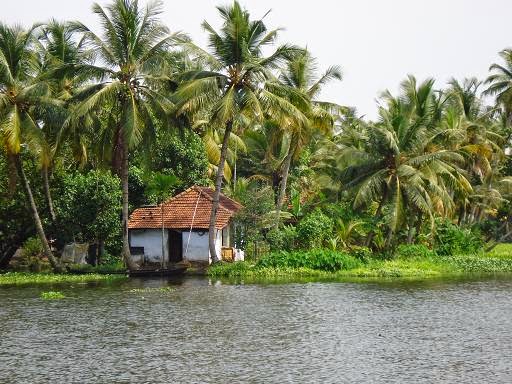
Coconut Palm grove and the backwaters of Kerala
The rivers and backwaters of Kerala always have been awesome for me, but regrettably I could not get much opportunities to experience it to the full. I have written about some aspects of those in one of my blog article (read 'my love and hate relationships with water')

The Backwaters of Kerala
Since most of my adulthood, I had spend outside Kerala, my exposure to the natural beauty of my home state is much limited. But whenever I visit my village, I keep thinking about the enormous potential of tourism in my home state. It is not that the Kerala government and the several private players have not done much on this. In fact they have done lot many things including the projection of Kerala as ' God's Own Country'! But whether they have done full justice to that phrase is a debatable issue.

Another House Boat in the Lake shore 
with the Coconut Palms
The first and last time that I could view the awesome glory of the Kerala backwaters, especially the Vembanad Lake in full was some time in 1969 when I was a high school student studying in the St. Thomas Higher Secondary School, Kozhencherry. Kozhencherry is a small town of Central Travancore area of Kerala located in the banks of the Pamba river. (Incidentally, this is the place where the now famous Mutthoot group began their small chit fund business decades ago. It is also the nearest town to the now failed Aranmula International Airport Project ) 

A large 7 Bedroom House Boat
In those days in the 1960's, tourism was not developed as an industry in Kerala. The Kerala roads and the water ways were much better maintained by the state government and the facilities were reasonably good when compared to the demands. My father allowed me to travel first time to the twin cities of Ernakulam-Kochi alone to book a railway ticket, a facility that existed only in the Ernakulam Railway station then. I could reach Ernakulam city situated about 120 km away from my home village, Elanthoor, within about 3 hours time then (some thing which is impossible now due to traffic congestion), travelling on a Fast Passenger bus operated by the Kerala State Road Transport Corporation (KSRTC). By the time I completed the task of booking the railway berth, it was late after noon. Now, the possibility of my returning back to my home village by bus posed some problem. There used to be KSRTC Fast Passenger buses that plied in the night and possibly one them could have taken me to Chengannur, the nearest major town located on the main central road of Kerala which is about 18 km away from my village. But by the time I reach, Chengannur, it would be late night and all public transports to my place would stop ( the situation is more or less the same even now!)
A Kuttanad Lake Side House in Kerala
So, I decided to get in to a lodge and stay there over night. In those days, a lodge room was available in Kochi for budget travelers within Rs.10/- per night! But before getting in to any lodge, I decided to have a stroll to the ferry that existed by on the banks of the Vembanad lake on the western side of the railway station. When I reached there, the time was about 8.00 PM. There were several big motor boats which looked almost similar to the KSRTC buses above the deck. They were like buses placed on kettuvallams! In fact, they were the public transport boats owned and operated by the Kerala Water Transport Corporation for the people of the Kuttanad region. When I reached there, I saw one of the boats with a prominent board placed on it reading-Chengannur. It was indeed a boat which was going to Chengannur. I had no idea how this boat from the backwaters would reach Chengannur through the water route! Any way I got it confirmed and got inside. The conductor was a little surprised initially, because it was the first time that he was getting a passenger who is boarding his boat for such a long trip from the starting point to the end point! The ticket charge was surprisingly low. It was just three and a half rupees- much lower than what I had to pay for the overnight stay in the lodge! The boat, as I was told, would be reaching Chengannur next day morning. It was just alright for me because I would be spending the whole night in the boat and in the morning I would get the bus from Chengannur to Elanthoor. It was my first experience on a diesel boat of the water transport corporation. As the boat started to move in to the depths of the sea like lake, I found it surprisingly smooth and with good speed. There were hardly a few passengers and they were all going to their water bound Kuttanad homes unlike me. I enjoyed the night view of Kochi from the boat as it moved away from the Kochi harbour beside several big ships anchored there. In another one or two hours time, heavy rains started. But it caused no problems for the boat or its travel. On its way, it stopped at different boat jetties and that process too was new to me. 
A Passenger Boat Moving in the Backwater Channels
The boat had two crews. One steered it from his cabin at the top while another operated its diesel engine from the engine room below the water line. The communication between them was just a string operated bell. Yet they worked quite in good synchronization without their boat making any wrong moves. Yet it did happen. Some time in the midnight, the boats propeller hit some thing and got partially damaged. It moved slowly afterwards upto Alleppey where it was placed in a boat workshop. It too was some thing new to me. I watched the whole process of boat repair with much enthusiasm during the night till dawn. After the repair, the boat moved again and entered the Pamba river. By the time it was already morning. I had the unique opportunity of watching the Kuttanad life by being in that boat till it reached the boat jetty of Chengannur which situated just below the MC road bridge. This boat jetty is no more functional now.
A Foreign Tourist Enjoying Sight Seeing in a House Boat
Years later some time in 2007 I got the second opportunity to make a small motor boat journey in Vembanad lake from the Alleppey side after the house boat tourism became much popular. The pictures in this blog page were taken during that time.
A Kuttanad House and its Common Transport Means
My non Keralite friends who happen to visit Kerala do tell me their appreciation of Kerala's natural beauty. I do agree with them. Kerala is unique in India and it is really beautiful when compared to the other Indian states. But had the Kerala government been a bit more careful with their administration, there are much more things they could have achieved in this state. Tourism industry could grow tremendously if they improve the roads, the transport, get more trained professional tourist guides, get more online travel portals, etc. Air travel to Kerala is much expensive as compared to some other air ports, even when it has three international airports within a span of 600 km.
A Luxury Hotel by the Lake Side
Kerala has been a centrally neglected state all through out because of the peculiar submissive nature of the Kerala politicians and bureaucrats who represented it in the Central government and its organizations. Kerala has been a non entreprising state always collectively, even while the Kerala people remained much more educated and industrious individually. The reason for this, in my opinion, is the peculiar political attitudes of the people. They fight each other on imaginary ideologies, totally ignoring the practical aspects of life and business. Because of this, Kerala businessmen are careful not to make themselves exposed much in the public! It is common knowledge that many Keralites are specialists in leg pulling. When they find some one among them successful, their sleep is lost and they may go all out secretly or openly to reverse the success of their fellow being!
The White Sandy Beach of Alleppey and the Arabian Sea
That is the reason why many Keralites prefer to venture out of their state to try their fortunes. Within their own state it requires far more efforts to become successful because of the pulls exerted by many of their local cousins. In a larger context, this is true to India as well. There are millions of successful Indians in the developed nations who are all contributing their knowledge and skills for making their second homes to prosper while they would have been just average performers within their own country because of the local pulls of other Indians at the home land! (Read more about this narrow mindedness in the blog I wrote yesterday)
The Waves of the Arabian Sea
Barring a few, most media in Kerala shy away from giving any publicity to news relating to business initiatives. I tried to get more information about the news that I mentioned in the beginning of this article. I could not find any of the Kerala online news papers covering this news of Shri Mohanlal inaugurating the new travel and tourism portal in Kerala.
 Scenic Beauty of Kuttanad!
In my opinion, it is high time that the Indian media learn to move away from the politicians and give undue importance to their thoughtless voices and acts. The public also should understand the futility of going after the politicians. If the politicians are doing some thing good for the nation, that should be acknowledged. Not otherwise! Instead, the wealth and job creators efforts should get more public appreciation. All businessmen who have become successful in creating large business organizations that provide worthwhile employment to the Indians should be appreciated more than the politicians.
Author's Niece Having A Hands On Experience!
Why some nations are highly developed while some others like India are not? Perhaps, talents and resources are more in India than perhaps all other nations. But regrettably, we lack the fundamental knowledge and attitudes that are required for efficient management of resources, including our human resources.
Near View of A Luxury Hotel and their Speed Boats
From personal experience, I have come to the conclusion that Indian organizational systems are antagonistic to progressive work. All our rules and procedures are based on mutual suspicion and fear. Perhaps it is all because the rules and procedures of Indian organizations are all made mostly by non-progressive narrow minded individuals. In many organizations, especially in the government controlled organizations, people simply cannot give their best out puts because the systems do not allow them to work! People are seldom provided the facilities that they require for executing their respective works in the appropriate times!
Another Kuttanad House
Often, the capable person to do a particular work is alienated and he or she may not be assigned any work. Instead, the work is likely to be assigned to persons who are not capable to do that work.

Incredible, is n't it? But then, that is the way things generally happen in India! Kerala is no exception!

I would request all the retired high officials of India to do some introspection in this context. How did they work when they were in power positions? Did they work as broadminded mentors? 

They should also give some thoughts on the ways and means by which the water tourism industry is promoted ensuring safety and security to the tourists. Accidents and untoward mishaps should not happen to mar the industry and the livelihood of the people who are depended on it. It is reported that the number of houseboats in the backwaters of Alleppey has already crossed one thousand. Do the government and the local authorities have some mechanism to improve the infrastructural facilities and the vigil?

Just sharing these thoughts with those who are capable of thinking positively.

Would you reciprocate with your reactions?

Wednesday, August 20, 2014

Paying Four Million in Bribes for Getting a Teacher's Job: Only Malayalees Can Do Such a Ridiculous Thing!

An year ago, some one told about me about an incidence in which a known Christian priest of a prominent Christian denomination in Kerala was asked to pay an incredibly high amount of Rs.4 Million [$67,000] as bribe by none other than some other Christian priests and bishops.

It is a general perception that bribes are paid to and are taken only by the government officers, staff and perhaps some politicians in authority. 

But this case was some thing different. Here the case was some thing involving bribe paying by Christian priests to Christian priests. Bribe being paid and taken by those who teach and preach about morality to the commons. Ridiculous or shameful ? I have no words.

The priest, as per the person who told me this,   had to pay this huge sum as bribe for getting his PhD-holder wife employed as a lecturer in a private educational institution run by a Christian educational society attached to a Kerala church denomination!

I could not believe it. 

Firstly because, the sum involved-Rs.4 Million- in my assessment is a very high amount in India for the middle class people. It is difficult for even a high ranking government official to have such a bank balance with the current levels of salary in this country. 

The net salary of a top ranking government official, net of income tax, is only about Rs 1.5 Million per year as of now. And this is the present situation as on 2014. Their net salaries were much lower to the tune of say Rs.0.5 million or lower a few years ago. It is highly improbable for any salaried person to have a bank balance of millions unless he had some other sources of income. I am not sure how many people have other sources or how legal such sources are!

I do not deny the fact of some one selling his ancestral landed property and making a kill, but that too is not that easy as people think. I also know the impact of the foreign exchange flow taking place in my home state which caused a boom in the real estate prices! 

While I have an idea about the legal incomes of a Christian priest in the major Kerala denominations, I have no idea about their other sources of incomes. Any way their legal incomes are no where near a class one government officer. 

Secondly, the salary of the lecturer in the initial years is only to the tune of about 0.3-0.4 million rupees gross in an year. Of course, after one or two decades, this could be a few times higher. A corpus fund of 4 million in a bank can yield a neat return of Rs.28000/- per month at the lowest bank interest rates as existing. If the person is able to save Rs.5000/- per month from this and invest that regularly in a recurring deposit yielding 8.5% per year for the next 30 years, he or she would have a corpus of nearly 10 Million in bank instead of the initial 4 million! 

Additionally, a person having a corpus fund of 4 million need not pay any insurance premium because he or she already has 4 million in bank. Otherwise he or she had to pay Rs.10000/- per month for having a life insurance cover of 4 million valid for 30 years! Thus effectively, a person having 4 million initially is to be deemed as an income earner of Rs.38000/- per month, totally risk free, with all possibilities of the corpus fund growing as the time passes! 

Further, a person having 4 million in bank can think of any vocation of his or her own choice without any botheration from any one. The options are numerous. Those who have entrepreneurship attitudes and qualities, the four million rupees in hand is indeed a big opportunity!

Let them not think of investing the corpus fund in high risk investments if they are not confident. In that case, the banks could use their funds professionally and make higher yields and pay them the minimum interest of 8.5 % from what they earned!

Again, I do not know how these people make these transactions. It has to be in hard cash, because bank transactions might give some clues to the authorities for fixing the persons concerned under various laws. But then, fixing the law enforcement people also through some bribes is not a big deal in a country where corruption is more-or-less an acceptable way of life!

But would such a thing be perpetuated by the Christian clergy and church leaders who keep voicing against all corrupt practices and evils of the society in almost all their preaching? Perhaps not. That was what I have been thinking!

With the above logic, my information was bound to be false. And I thought it that way. But the TV channels of Kerala proved me wrong a few weeks ago. 

They showed me and the whole Malayalees of the world some thing we have been considering as rumors only. In real life we never thought it to be happening! 

I was stunned when the TV channels beamed their spy camera clippings that showed some people responsible for managing some private schools with substantial government aid, asking for bribe money to the order that I mentioned in the beginning of this article, from a Christian priest for appointment of the latter's wife as a teacher. 

Those asking for the bribe this time included a bishop, another priest and others who are all the office bearers of the Society that managed the educational institution. 

Remember, this was a recent incident and it was not the one I stated initially. It proved that the rumors running around are not rumors, but a routine practice! [Read this]

The channels subsequently came up with several of such spy camera revelations. The bribe money for appointment of teachers in government aided private schools of Kerala appears to be with the larger involvement of the political class and the so called non profit religious organizations. Christians are not the only exceptions!

This kind of a situation perhaps would not have been happening outside Kerala. I am not telling that non-Malayalees are all puritans. No, that is not the case. 

But, a Gujarati for example, would not pay millions for a peanut paying job of a private school teacher! Instead, he or she would start his or her own school or some thing similar to it. That is the difference between the Gujarati and the Malayali mindsets.

So there are so many such foolish Malayalees who are willing to pay in millions for a peanut paying job of a teacher and they do not have the brains to understand their foolishness. And there are other local Malayalees who exploit this mindset. Does it indicate the lack of entrepreneurship in Malayalees? 

Perhaps, yes. Perhaps I am wrong. Perhaps they are more calculative!

Some of the Christian leaders were later justifying their situation. When the political authorities are asking for such bribes, they are simply helpless, they argue. For running their institutions this is the only method, they say. 

Okay, I agree with them for a moment. But then they should stop preaching morality, at least! That is the minimum good thing that they can do to the people.

This is not any exception. I have direct information about Christian run educational institutions and other charity organizations becoming wise and practical as per the needs of the current age.

I am also aware of the various tricks and favoritism that keep happening within the organized churches in India, just as they happen all over the world. While the churchmen preach about the story and interpretations of Jesus calling such people 'whitewashed tombs in Matthew 23:27' they keep doing the same!

Doing a sin for a good cause does not make the sin, holy! 

We can not help it. People are people after all. To live like a true human being by willfully discarding greed, selfishness and such other negative qualities is becoming more and more difficult for many of us. 

We are in a world of temptations that does not even spare our religious and spiritual leaders!

But can't we not overcome our temptations?

Can't we not use our God given wisdom?


Monday, August 4, 2014

Bankbazaar: The Best Online Site for Making Well Informed Decisions on Bank Loans, Bank Deposits and Insurance in India

Post liberalization and with the prolific growth of digital information technology (IT) and IT-enabled services, India has become a hot spot of both software companies and companies that offer IT enabled services such as banking, insurance, data processing, data storage, online trading, etc.

The companies in this sector provided millions of job opportunities with relatively good salaries to the young men and women of India who have the essential qualifications for getting employment in these specialized field of work.

The IT related business potential has been something which the old timers just could not dream just a couple of decades ago. The business models that the youngsters devised have created great wealth many times than the conventional business models. 

Being an old timer myself, I have been an awe admirer of the potential of computer software and the internet in raking up large scale economic activities and creating wealth for the individuals and the corporations.

A stage has come now that the computer systems have become an inseparable part of all human beings who have crossed over the threshold of basic development. 

The higher incomes that the IT and IT-enabled business have provided enhanced aspirations of young Indians for better housing, comforts, leisure and better services from the service providers. In turn it has been facilitating more avenues for entrepreneurs to come up with revolutionary ideas for providing better services to the customers.

Banks have been one of the first business sectors in India to shed the old style working replaced with computerization. In the retail banking, it has now become almost paperless. Several Indian banks have opted for advanced IT infrastructure and systems. 

The IT savvy population of India can now do almost all their retail banking requirements without they ever visiting the banks. They are now in a position to do it from the PC terminals or their mobile phones without leaving their comfort zones of the office, home or even while on the move. 

They could now see their bank accounts, buy many goods and services and pay online, transfer money to others, make recurring deposits (RD), fixed deposits (FD), know their income tax dues, file IT returns, pay for the services, etc.

But in the mean time, the banks have also become more flexible with every bank offering several options for each service. While outwardly all banking services looked similar, in reality they have become dissimilar. The interest that you actually get for your deposits, the interest rates and equated monthly installments that is applicable for your loans, etc are all different in different banks.

Imagine the difficulty that you face to discuss these things with each every bank before you can finally take a decision. The bank officials to whom you might talk could even be ignorant with regard to the various rules as applicable that you could get highly confused or misguided.

This complexity has initiated the thought process in a group of young and experienced engineers in the IT field that they have evolved a business model that provides a win-win situation for the individuals, the banks and themselves.

And this is the fast growing IT-enabled business called the Bankbazzar (literally meaning the market place of the banks) which got into this unique business sometime in 2008. [Read about Bankbazaar in this Wikipedia article] It was founded by a group of young and experienced Indian engineers [Read about some of them here]

Bankbazaar is wholly for the Indian people as of now. Let us see what all services this dotcom company provides to the customers in India:

It facilitate you to compare the HOME LOAN offers of various banks and finalize the best deal. 

Bankbazaar is the best place for you to compare the various CAR LOAN options from various Indian banks and zero in to the best one suitable for you.

And some of you may need a personal loan for some immediate needs. Banks usually charge higher interest rates for personal loans and they all have different interest rates, EMIs, processing charges, etc. BANKBAZAAR PERSONAL LOAN page would facilitate one to chose the best offer and finalize it. 

Bankbazaar website has many other useful features such a EMI calculators with special regard to the Indian banks, refinance calculators, Interest calculators, etc. One can access the various ONLINE CALCULATORS of this facilitating company for taking best informed decisions. 

It also provides those interested in investments to read informative articles about finance and investments in India.

One can also chose to get a suitable Credit Card from those banks in India that offer such a facility. 

In case you have surplus money, you can invest it safely in FDs of banks. But now-a-days different banks have different schemes and interest rates. Bankbazaar allows one to select the best deposit scheme and apply online for making the FIXED DEPOSITS

Bankbazaar also provides you facilities to decide the best suited LIFE INSURANCE from the best company of your choice.

It is not a bad idea to do a bit research before you take loans, put money in FDs or to take an insurance policy.

Finally, a word of caution. Take a loan only when it is unavoidable and when you have the resources and income to pay the EMIs.

Never take a loan which has an EMI which eats out the major portion of your monthly income.