

How much electrical energy you use in a month for your very justified needs? How much money you pay to the electricity utility company per month for your electricity?
Many of us Indians do understand the importance of saving energy, but we really are very reluctant to do something about it.
Ceiling fans are one of the electrical appliances which have come almost an indispensable in Indian homes and offices. In many middle class Indian homes at least one ceiling fan keep running on an average 20 hours a day for almost 300 days in an year.
Ceiling fans are not normally considered as high energy consuming devices. At least that is the general public perception.
A couple of decades ago, it was common that a ceiling fan with its speed regulator used to consume about 80 to 100 watts of electricity an hour.
With more and more energy efficient designs and with the introduction of electronic speed regulators, the average electrical power consumption of a normal sized ceiling fan has come down in the recent years. The best energy efficient ceiling fans as manufactured by reputed ceiling fan manufacturers now come with a wattage in the range of 45 to 60 watts. Ceiling fans now come with Bureau of Energy Efficiency (BEE) star ratings. A few reputed suppliers have now 5 star rated ceiling fans which is considered as the best with respect to energy efficiency.
For example a five star rated 1200 mm sweep ceiling fan of a reputed make consumes about 45 watts combined with its electronic speed regulator and costs about Rs. 2000/- per set. Larger fans of higher sweep may consume a few more watts per hour and costs a few hundred rupees more.
I was wondering whether there could be any further improvement in this regard and found that one Indian manufacturer has begun manufacturing and marketing a remarkably super efficient ceiling fan in the Indian market.
This fan is marketed in the brand name-Superfan. It is manufactured by an innovative technology company located in south India called Versa Drives Private Limited, Coimbatore.

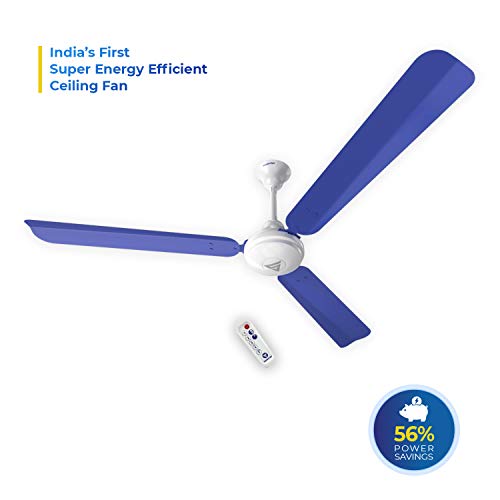
click the images for more details and buying them online
They manufacture many models of their super energy efficient ceiling fans in the superfan brand. You may visit this webpage for the technical details and also buying these models.
These models have sweep sizes of 1200 mm and 1400 mm and are all with the highest BEE energy star rating of five.
All these models have a maximum energy consumption ranging from 35 to 38 watts much lower than the best efficient models of other Indian manufacturers.
Unlike conventional ceiling fans superfan models come in attractive colors. These hi tech fans do not require the regulator and are operated using remote controls. They are provided with very interesting and useful features.
Suppose that you are using a normal ceiling fan which consumes about 60 watts of electrical energy. Suppose that you use this fan for about just one hour in a day.
That means you will use 60/1000 KW x 1 hr x 30 d = 1.8 KWh or units of electricity per month on account of this one fan used for just one hour a day.
Now a good majority of middle class homes in India have 3 to 4 ceiling fans and their combined use could be anything in the range of 10-20 hour in a day or even higher. That means a monthly electric consumption of 18 to 36 units or more on account of the fans.
Now suppose that you replace these fans by these superfans which consume only about 35 watts instead of the 60 watts of your old fans.
The net saving per fan is 25 watts per hour or about 0.75 units in a month for every hour of daily use of the fan.
If on the average your total daily use is 10 hours, your save 7.5 units. If it is 20 hours, you save 15 units.
The electricity tariff in most Indian cities and states are based on slab system. For example, Kerala used to be a state with lower electricity charges of less than a rupee per unit in the past for the domestic consumers whose consumption was less than 50 units per month. But in the recent years this has become more than double and stands at Rs. 2.8 per unit. For a family which uses over 200 units, the rate of tariff is R.7 per unit. [See this news report]
In some states and in some cities, the rates are higher and the electricity charges is on an increasing trend. In the national capital Delhi, the rates are much higher. The rising electricity charges have become one of the major political issues there.
In some states and in some cities, the rates are higher and the electricity charges is on an increasing trend. In the national capital Delhi, the rates are much higher. The rising electricity charges have become one of the major political issues there.
There are many other hidden charges as well. The commercial rates are much higher. Due to the slab system and the various hidden charges such as meter rent, installation cost, taxes, etc the actual cost varies from place to place.
Effectively, the average cost per unit (KWh) of electricity come out to be to the tune of 5 to 7 rupees as of now. It would keep rising year after year.
India is becoming a power starved nation as the gross deficit in energy keep rising every year. Again, electricity production enhances various kinds of environmental hazards.
All these are ample reasons for India to find ways to curtail its energy consumption. Conservation of energy should be one of the prime policies for India.
Suppose you are able to save 15 units of electricity in a month by using super efficient ceiling fans. At Rs.5 per unit, you save Rs.75 in a month or Rs.900/- in an year. [You can calculate the savings and see the difference in this superfan webpage]
Effectively, the average cost per unit (KWh) of electricity come out to be to the tune of 5 to 7 rupees as of now. It would keep rising year after year.
India is becoming a power starved nation as the gross deficit in energy keep rising every year. Again, electricity production enhances various kinds of environmental hazards.
All these are ample reasons for India to find ways to curtail its energy consumption. Conservation of energy should be one of the prime policies for India.
Suppose you are able to save 15 units of electricity in a month by using super efficient ceiling fans. At Rs.5 per unit, you save Rs.75 in a month or Rs.900/- in an year. [You can calculate the savings and see the difference in this superfan webpage]
Due to superior technology, superfan models are costlier than other normally available ceiling fans in India. One may have to spend about Rs. 3000- 3500 for one superfan model while lesser efficient ceiling fans could be purchased at half the cost.
But these fans are worth that cost the additional cost is paid back within two or three years time. Besides these fans are aesthetically good looking and improves the decor of the home or office.
Suppose that about 5 million homes in Kerala state replace their fans with this new fan and save 15 units of electricity per month. With that kind of a saving, Kerala can immediately divert about 100 MW of electric power for industrial production! It amounts to about 16% of electricity production from the states biggest hydel electricity production facility at Idukki!
I have just given an indicative energy saving potential by adopting a simple step. Energy saving by replacing the filament type electric bulbs with compact florescent lights (CFL) has given much saving in the past. Now, Light Emitting Diode (LED) bulbs are revolutionizing it. A 100 W filament bulb is more or less equivalent to a 40 W florescent tube which in turn is equivalent to an 11 W CFL. But an LED bulb of 4-5 W has the potential to reduce even that to half or even lesser. But at the present costs, the capital costs involved in saving one watt of lighting power by replacing CFL with LED comes to about Rs.50 per watt. The difference in price of a 5 W LED bulb and an 11 W CFL is about Rs.250. The LED light is costlier by about Rs.250.
A superfan too would be costlier in the same way as compared to a normal 5star energy efficient fan of equivalent capacity. But the superfan saves 25 W of electricity more than any other 5 star rated ceiling fan in the Indian market now.
Some time ago, superfan models were not very much available with the Indian retailers.
But now the manufacturers of this fan, it seems, have adopted better marketing actions. Superfans can now be procured online from reputed e-shopping sites such asAmazon!
It is indeed a good thing.
This is indeed a good independent make-in-India initiative, though established before the present 'Make-in-India' campaign and needs to be appreciated.
While individual citizens can contribute much for energy saving by taking care of those few watts or kilowatts of power they consume for domestic purposes for fans, lights and other domestic electrical appliances, the potential for energy saving by commercial establishments too is substantial.
Imagine the national and individual savings when our offices install energy efficient fans, lights and air-conditioners in place of the old less efficient electrical equipment!
What is needed is a bit more attention to the details of our energy consumption by doing some energy audit and taking corrective actions.
Remember! Every watt of power saved not only gives financial benefits, but also save our environment from becoming more and more polluted. By using energy efficient electrical appliances and using them judicially, you could even save enough to consider taking another bank loan for some other purpose as your monthly energy saving could be equivalent to another loan EMI!
Our industrial design engineers and entrepreneurs should be encouraged to design and produce energy efficient appliances. But these fans are worth that cost the additional cost is paid back within two or three years time. Besides these fans are aesthetically good looking and improves the decor of the home or office.
Suppose that about 5 million homes in Kerala state replace their fans with this new fan and save 15 units of electricity per month. With that kind of a saving, Kerala can immediately divert about 100 MW of electric power for industrial production! It amounts to about 16% of electricity production from the states biggest hydel electricity production facility at Idukki!
I have just given an indicative energy saving potential by adopting a simple step. Energy saving by replacing the filament type electric bulbs with compact florescent lights (CFL) has given much saving in the past. Now, Light Emitting Diode (LED) bulbs are revolutionizing it. A 100 W filament bulb is more or less equivalent to a 40 W florescent tube which in turn is equivalent to an 11 W CFL. But an LED bulb of 4-5 W has the potential to reduce even that to half or even lesser. But at the present costs, the capital costs involved in saving one watt of lighting power by replacing CFL with LED comes to about Rs.50 per watt. The difference in price of a 5 W LED bulb and an 11 W CFL is about Rs.250. The LED light is costlier by about Rs.250.
A superfan too would be costlier in the same way as compared to a normal 5star energy efficient fan of equivalent capacity. But the superfan saves 25 W of electricity more than any other 5 star rated ceiling fan in the Indian market now.
Some time ago, superfan models were not very much available with the Indian retailers.
But now the manufacturers of this fan, it seems, have adopted better marketing actions. Superfans can now be procured online from reputed e-shopping sites such asAmazon!
It is indeed a good thing.
This is indeed a good independent make-in-India initiative, though established before the present 'Make-in-India' campaign and needs to be appreciated.
While individual citizens can contribute much for energy saving by taking care of those few watts or kilowatts of power they consume for domestic purposes for fans, lights and other domestic electrical appliances, the potential for energy saving by commercial establishments too is substantial.
Imagine the national and individual savings when our offices install energy efficient fans, lights and air-conditioners in place of the old less efficient electrical equipment!
What is needed is a bit more attention to the details of our energy consumption by doing some energy audit and taking corrective actions.
Remember! Every watt of power saved not only gives financial benefits, but also save our environment from becoming more and more polluted. By using energy efficient electrical appliances and using them judicially, you could even save enough to consider taking another bank loan for some other purpose as your monthly energy saving could be equivalent to another loan EMI!
Government should consider giving incentives for such initiatives.


