Powered By Blogger
Showing posts with label Kerala. Show all posts

Saturday, September 20, 2014

Kerala House Boat Tourism and Some Thoughts Arising From It!

A speeding House Boat in the Vembanad Lake of Alleppey

I was very delighted to see a small news clip in a Malayalam TV channel yesterday about the inauguration of an internet portal that provided travel enthusiasts the much needed information about the Kerala luxury house boats.
A small wooden boat in the approach channel 
to Vembanad Lake at Alleppey
This new online Kerala House Boat information and booking website which came into official existence is www.myboattrip.com which is a safe and secure website.

 
An Alleppey House Boat
The ever shining Malayalam actor Mohanlal [മോഹന്‍ലാല്‍] reportedly inaugurated this website which is an initiative by M/s Safe Boat Trip Private Limited of Kerala.

A House Boat in the Backwaters of Kerala
The house boat tourism began in the back waters of Kerala a couple of decades ago in a big way when an enterprising Kerala businessman built the first luxury houseboat for tourism purposes, spending millions. But houseboats called kettuvallam (കെട്ടുവള്ളം) have been in existence in Kerala rivers and backwaters perhaps for centuries. They have been used for days long journeys through the calm backwaters and rivers of Kerala. I remember enjoying a lunch inside a kettuvallam during my early childhood days. It was owned by some of our relatives who lived in the water locked Kuttanad area who came all the way travelling through the Pamba river to attend the famous Christian annual convention called the Maramon Convention. That was some time in the Nineteen Sixties. 
Coconut Palm grove and the backwaters of Kerala
The rivers and backwaters of Kerala always have been awesome for me, but regrettably I could not get much opportunities to experience it to the full. I have written about some aspects of those in one of my blog article (read 'my love and hate relationships with water')

The Backwaters of Kerala
Since most of my adulthood, I had spend outside Kerala, my exposure to the natural beauty of my home state is much limited. But whenever I visit my village, I keep thinking about the enormous potential of tourism in my home state. It is not that the Kerala government and the several private players have not done much on this. In fact they have done lot many things including the projection of Kerala as ' God's Own Country'! But whether they have done full justice to that phrase is a debatable issue.

Another House Boat in the Lake shore 
with the Coconut Palms
The first and last time that I could view the awesome glory of the Kerala backwaters, especially the Vembanad Lake in full was some time in 1969 when I was a high school student studying in the St. Thomas Higher Secondary School, Kozhencherry. Kozhencherry is a small town of Central Travancore area of Kerala located in the banks of the Pamba river. (Incidentally, this is the place where the now famous Mutthoot group began their small chit fund business decades ago. It is also the nearest town to the now failed Aranmula International Airport Project ) 

A large 7 Bedroom House Boat
In those days in the 1960's, tourism was not developed as an industry in Kerala. The Kerala roads and the water ways were much better maintained by the state government and the facilities were reasonably good when compared to the demands. My father allowed me to travel first time to the twin cities of Ernakulam-Kochi alone to book a railway ticket, a facility that existed only in the Ernakulam Railway station then. I could reach Ernakulam city situated about 120 km away from my home village, Elanthoor, within about 3 hours time then (some thing which is impossible now due to traffic congestion), travelling on a Fast Passenger bus operated by the Kerala State Road Transport Corporation (KSRTC). By the time I completed the task of booking the railway berth, it was late after noon. Now, the possibility of my returning back to my home village by bus posed some problem. There used to be KSRTC Fast Passenger buses that plied in the night and possibly one them could have taken me to Chengannur, the nearest major town located on the main central road of Kerala which is about 18 km away from my village. But by the time I reach, Chengannur, it would be late night and all public transports to my place would stop ( the situation is more or less the same even now!)
A Kuttanad Lake Side House in Kerala
So, I decided to get in to a lodge and stay there over night. In those days, a lodge room was available in Kochi for budget travelers within Rs.10/- per night! But before getting in to any lodge, I decided to have a stroll to the ferry that existed by on the banks of the Vembanad lake on the western side of the railway station. When I reached there, the time was about 8.00 PM. There were several big motor boats which looked almost similar to the KSRTC buses above the deck. They were like buses placed on kettuvallams! In fact, they were the public transport boats owned and operated by the Kerala Water Transport Corporation for the people of the Kuttanad region. When I reached there, I saw one of the boats with a prominent board placed on it reading-Chengannur. It was indeed a boat which was going to Chengannur. I had no idea how this boat from the backwaters would reach Chengannur through the water route! Any way I got it confirmed and got inside. The conductor was a little surprised initially, because it was the first time that he was getting a passenger who is boarding his boat for such a long trip from the starting point to the end point! The ticket charge was surprisingly low. It was just three and a half rupees- much lower than what I had to pay for the overnight stay in the lodge! The boat, as I was told, would be reaching Chengannur next day morning. It was just alright for me because I would be spending the whole night in the boat and in the morning I would get the bus from Chengannur to Elanthoor. It was my first experience on a diesel boat of the water transport corporation. As the boat started to move in to the depths of the sea like lake, I found it surprisingly smooth and with good speed. There were hardly a few passengers and they were all going to their water bound Kuttanad homes unlike me. I enjoyed the night view of Kochi from the boat as it moved away from the Kochi harbour beside several big ships anchored there. In another one or two hours time, heavy rains started. But it caused no problems for the boat or its travel. On its way, it stopped at different boat jetties and that process too was new to me. 
A Passenger Boat Moving in the Backwater Channels
The boat had two crews. One steered it from his cabin at the top while another operated its diesel engine from the engine room below the water line. The communication between them was just a string operated bell. Yet they worked quite in good synchronization without their boat making any wrong moves. Yet it did happen. Some time in the midnight, the boats propeller hit some thing and got partially damaged. It moved slowly afterwards upto Alleppey where it was placed in a boat workshop. It too was some thing new to me. I watched the whole process of boat repair with much enthusiasm during the night till dawn. After the repair, the boat moved again and entered the Pamba river. By the time it was already morning. I had the unique opportunity of watching the Kuttanad life by being in that boat till it reached the boat jetty of Chengannur which situated just below the MC road bridge. This boat jetty is no more functional now.
A Foreign Tourist Enjoying Sight Seeing in a House Boat
Years later some time in 2007 I got the second opportunity to make a small motor boat journey in Vembanad lake from the Alleppey side after the house boat tourism became much popular. The pictures in this blog page were taken during that time.
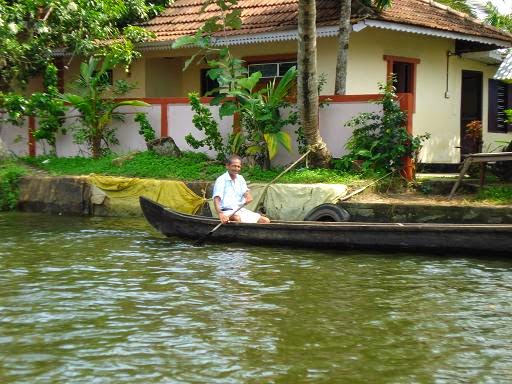
A Kuttanad House and its Common Transport Means
My non Keralite friends who happen to visit Kerala do tell me their appreciation of Kerala's natural beauty. I do agree with them. Kerala is unique in India and it is really beautiful when compared to the other Indian states. But had the Kerala government been a bit more careful with their administration, there are much more things they could have achieved in this state. Tourism industry could grow tremendously if they improve the roads, the transport, get more trained professional tourist guides, get more online travel portals, etc. Air travel to Kerala is much expensive as compared to some other air ports, even when it has three international airports within a span of 600 km.
A Luxury Hotel by the Lake Side
Kerala has been a centrally neglected state all through out because of the peculiar submissive nature of the Kerala politicians and bureaucrats who represented it in the Central government and its organizations. Kerala has been a non entreprising state always collectively, even while the Kerala people remained much more educated and industrious individually. The reason for this, in my opinion, is the peculiar political attitudes of the people. They fight each other on imaginary ideologies, totally ignoring the practical aspects of life and business. Because of this, Kerala businessmen are careful not to make themselves exposed much in the public! It is common knowledge that many Keralites are specialists in leg pulling. When they find some one among them successful, their sleep is lost and they may go all out secretly or openly to reverse the success of their fellow being!
The White Sandy Beach of Alleppey and the Arabian Sea
That is the reason why many Keralites prefer to venture out of their state to try their fortunes. Within their own state it requires far more efforts to become successful because of the pulls exerted by many of their local cousins. In a larger context, this is true to India as well. There are millions of successful Indians in the developed nations who are all contributing their knowledge and skills for making their second homes to prosper while they would have been just average performers within their own country because of the local pulls of other Indians at the home land! (Read more about this narrow mindedness in the blog I wrote yesterday)
The Waves of the Arabian Sea
Barring a few, most media in Kerala shy away from giving any publicity to news relating to business initiatives. I tried to get more information about the news that I mentioned in the beginning of this article. I could not find any of the Kerala online news papers covering this news of Shri Mohanlal inaugurating the new travel and tourism portal in Kerala.
 Scenic Beauty of Kuttanad!
In my opinion, it is high time that the Indian media learn to move away from the politicians and give undue importance to their thoughtless voices and acts. The public also should understand the futility of going after the politicians. If the politicians are doing some thing good for the nation, that should be acknowledged. Not otherwise! Instead, the wealth and job creators efforts should get more public appreciation. All businessmen who have become successful in creating large business organizations that provide worthwhile employment to the Indians should be appreciated more than the politicians.
Author's Niece Having A Hands On Experience!
Why some nations are highly developed while some others like India are not? Perhaps, talents and resources are more in India than perhaps all other nations. But regrettably, we lack the fundamental knowledge and attitudes that are required for efficient management of resources, including our human resources.
Near View of A Luxury Hotel and their Speed Boats
From personal experience, I have come to the conclusion that Indian organizational systems are antagonistic to progressive work. All our rules and procedures are based on mutual suspicion and fear. Perhaps it is all because the rules and procedures of Indian organizations are all made mostly by non-progressive narrow minded individuals. In many organizations, especially in the government controlled organizations, people simply cannot give their best out puts because the systems do not allow them to work! People are seldom provided the facilities that they require for executing their respective works in the appropriate times!
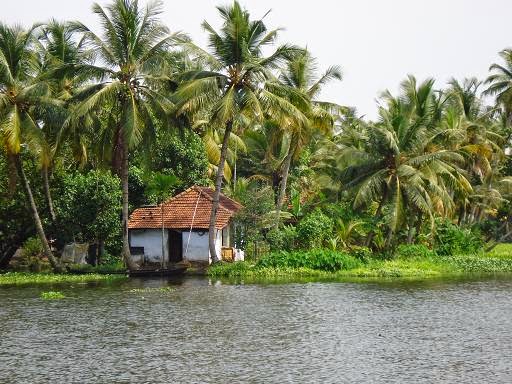
Another Kuttanad House
Often, the capable person to do a particular work is alienated and he or she may not be assigned any work. Instead, the work is likely to be assigned to persons who are not capable to do that work.

Incredible, is n't it? But then, that is the way things generally happen in India! Kerala is no exception!

I would request all the retired high officials of India to do some introspection in this context. How did they work when they were in power positions? Did they work as broadminded mentors? 

They should also give some thoughts on the ways and means by which the water tourism industry is promoted ensuring safety and security to the tourists. Accidents and untoward mishaps should not happen to mar the industry and the livelihood of the people who are depended on it. It is reported that the number of houseboats in the backwaters of Alleppey has already crossed one thousand. Do the government and the local authorities have some mechanism to improve the infrastructural facilities and the vigil?

Just sharing these thoughts with those who are capable of thinking positively.

Would you reciprocate with your reactions?

Saturday, September 6, 2014

Will the Liquor Prohibition in Kerala Going to Drive the Last Nail to the Congress' Coffin?

Let me clarify this first. I am not an alcohol proponent. At the same time, I am also not a supporter of the prohibitionists. I do not consider social drinking a grave sin. I am not a social drinker. At the same time, I am also not a nut-headed puritan who claims to be a teetotaler or drink hater for life!

Fate of Toddy Shops Is Not Clear!
Similar is my view with regard to tobacco too. That is my view with regard to any thing for human consumption. 

Any thing in excess and without restraint or without proper application of mind is damaging and could cause problems. That is my take on it.

I am neither a smoker of tobacco nor a drinker of alcohol. But, at the same time, they are neither any kind of a taboo for me!

Of course, these substances may pose problems of addiction and behavioral complications for immature people when taken without restraint on a regular basis. Neither do they do any benefit to people!

But all such so called vices of drugs, wine and other taboo pleasures have been in existence from time immemorial among all communities of humans. These things do have some influencing attraction to many people.

The Bible has many verses that describe various aspects of drinking wine and such intoxicating liquors. But the Bible does not forbid the faithful from drinking alcohol containing drinks. For example, Psalm 104:14-15 it is written like this:


"You cause the grass to grow for the livestock
and plants for man to cultivate,
that he may bring forth food from the earth
 and wine to gladden the heart of man,
oil to make his face shine
and bread to strengthen man's heart".

But the Bible surely advises people against drunkenness: In Ephesians 5:18 the Bible advises like this:

        "And do not get drunk on wine, in which lies debauchery"


But in 1 Corinthians 6:12 the Apostle Paul makes things very clear like this:

"All things are lawful unto me, but all things are not expedient: all things are lawful for me, but I will not be brought under the power of any".

In a similar way, the Quran too does not categorically forbid drinking alcohol containing drinks. This article gives much details about what the Quran actually says.

Neither do the other scriptures of the other major religions say any thing against in this context. In fact, all religions and the human wisdom advise people to be wise in their decision making, just as St.Paul had summarized it. 

I have written this much because of the current controversy over the Congress led state government of Kerala deciding to ban liquor sale in this other wise liquor loving southern state of Kerala. The whole issue emerged suddenly out of some liquor politics that some politicians of Kerala played for some apparent advantage that they thought as wise from their point of view!

If any one makes a hue and cry for alcohol prohibition in that state, he or she is not doing it from the strength of any holy scriptures, but on the basis of shrewd politics with hidden vested interests.

Yes, alcohol business is indeed a big money business with high stakes involved. When a business is too obviously high yielding, rivalry among the various stake holders is just a matter of natural consequence. It is indeed a well known fact that in today's democratic politics, the so-called religious leaders play their own fiddles for and against politicians!
Hotels of 5 star and Above Would Not Be Affected!
If some religious leaders have done that in Kerala now, it is no big surprise. But by obliging them, the current in-power politicians have done a grave mistake of their life! 

Some people hate the thought of meat eating. They are pure veggies. At the same time, some others hate the thought of living only on vegetable foods alone. Even in these non-veg lovers, there are sub groups who hate one kind of meat from the other.

While admitting the possibility of having many immature males of this state spoiling their lives and families due to alcoholism, prohibition of liquor in the state, the way it is being proposed to be done in the state by the state government with the activist support of some religious leaders, to my view, is a political harakiri being done by the already routed Congress party. It is going to drive the last nail to the Congress party's coffin!

Liquor is undoubtedly a big booster of the travel and tourism business. While, liquor may be a problem for some individuals, it is not such a thing for many of the higher classes of people, especially the tourists to the state which is now highly dependent on the tourism industry. Nearly a million foreigners and ten million domestic travelers visit Kerala every year as per the latest available statistics.

Knowledgeable industry sources estimate an immediate drop of 40-50% of that tourist traffic because of the liquor prohibition that the marginalized Congress government is implementing in this state. Imagine the great loss to the already sick economy of this state! Imagine the great losses in employment opportunities! The ineffective Kerala governments have not been in a position to enhance the state's infrastructure and employment potentials in line with the demands. And by doing this, they would do further harm to the economy.

Had they been really worried about stopping drunkenness among some alcoholic Malayalees, they would have done some well thought mechanism other than this thoughtless prohibition. But when, their times are not good, they are bound to take such self destructive actions! I would have supported any idea for making the state's country sides and lanes free from foul smelling booze in the late evenings and getting it free from those drunken fellows who behave as anti-socials the moment they gulp some cheap liquor! But going by the past experiences, prohibition in the manner it is proposed now would only enhance the anti-social activities in the state with higher incidences of spurious liquor and drugs!

In a way, perhaps this is going to be good. The decade's old see-saw game of governance by the left and the right would go for good in the state in the near future.

Let us wait and watch!

Wednesday, November 20, 2013

The Proposed Aranmula Airport of Central Kerala: A Typical Test for Democracy in an Yet-to-Mature Society!

The place called Aranmula [ആറന്‍മുള  in Malayalam, the language of the Kerala people] is hardly four kilometers from my ancestral home in Elanthoor [ഇലന്തൂര്‍ ]. Both these places are peaceful places in the central Travancore region [മദ്ധ്യ തിരുവിതാംകൂര്‍] of Kerala State in south India. 

Aranmula has been well known  for mainly three things. 

One is the Aranmula Metal Mirror called Aranmula kannadi [ആറന്‍മുള കണ്ണാടി] which is a polished metallic mirror made traditionally by some traditional artisan families of this place in some special alloy mix. This traditional knowledge got almost extinct some years ago, only to be revived again, thanks to the prominence of Kerala in the international tourism in the recent years.
Next is the Aranmula Boat Race or vallamkali [വള്ളംകളി] , a traditional water sport conducted in special wooden boats called chundanvallams [ചുണ്ടന്‍വള്ളം ] or snake boats. This is associated with a Hindu religious tradition of the Aranmula Parthasarathi temple [ആറന്‍മുള പാര്‍ഥസാരഥി ക്ഷേത്രം] which is the other thing that makes this place famous. The boat race takes place in the Pamba river [പമ്പാ  നദി ] during the days of Onam [ഓണം]  when the river has enough water. Now-a-days, due to a few hydro electric projects and dams, the river does not have much water during the season and the state government releases water for a few days to help the traditional boat race to be conducted without much difficulty.

But if you consider development and infrastructure in the modern viewpoints, Aranmula can hardly be seen as a developed place. None of the famous things that I  mentioned are visible for a common traveler who happens to pass through this place by road, the only major road through this place which connects the towns of  Kozhencherry [കൊഴെന്‍ചേരി] and Chengannoor [ചെങ്ങന്നൂര്‍] with the nearby district headquarter town, Pathanamthitta [പത്തനംതിട്ട]

All these places in the central travancore area have been traditionally famous for its religious harmony among its peoples who are mostly Hindus, Syrian Christians and Muslims. The Hindus are the major religious community with the Nair [നായര്‍] castes and the Ezhava [ഈഴവ] castes numbering the most. The upper caste Hindus, many of whom associated with the erstwhile travancore royal families have been the traditional land lords of this area. However, the Christians too have prospered much in recent decades and many from this community are very rich due to education and opportunities some of their peoples tried out in trade, plantations and foreign employments. 

When neo rich communities emerge, it is quite natural for people to develop jealousies and suspicions against each other. Typical cases of such happenings that culminated in to tragic holocausts and human tragedies are fresh in the minds of at least a few among the world community even now. I am referring to the tragedies the Jews faced in Germany during world war -2, the upper class faced in Combodia , the Hindus and Muslims faced during India before and after partition, the Sikhs faced in India during the early Eighties, the Chinese faced during world war-II and similar other events, small and big.

Fortunately, Keralites of modern times are in general well mannered and educated and they would not resort to such inhuman acts, even while some of them keeping some jealousies and animosities deep in their minds. Those deep rooted jealousies and animosities could surface as peaceful or violent conflicts cleverly disguised as issues relating to environment, animal welfare, traditions, labor and the like, when issues of public interests are initiated to be resolved.

The general opposition of a majority of people of the local community to the proposed Aranmula International Airport project is to be understood against this background.

Ever since the Indian government moved away from socialism and embraced a mixed culture of halfhearted capitalism in the Nineties, what actually suffered a great deal in India is infrastructural development. Government almost stopped spending on infrastructure requiring major budgetary support such as airports, air transport, harbors, shipping, highways, road transport, postal service, education, telecom, etc all of which used to depend much on governmental support earlier. Instead, there was a major policy change wherein the government seemed to encourage private participation in these areas. Regrettably on account of various reasons, the Indian government could not install firmed up policies and laws which would be a win-win situation for all the stake holders in some generally acceptable manner maintaining reasonable transparency in its decisions, in this regard.

In Kerala, the Cochin International Airport Limited [CIAL] was one major successful project which got implemented specklessly during this time as a beautiful example of private-public participation with a determined and efficient leadership provided by a politically handpicked administrator belonging to the Indian Administrative Service (IAS). In a similar manner another one of its kind in north kerala, named the Kannur International Airport Limited [KIAL] is being planned. The small, but highly developed state of Kerala, is perhaps the only state in India with three working international airports within a span of about 600 kilometers and yet another in the making. If the proposed KGS Aranmula International Airport Limited becomes operational, this state Kerala would have five international airports in the same distance. Indeed a remarkable achievement for any Indian state!

If the plans of the Indian government goes well, all the commercial airports in India would become privatized in the near future.

Now, coming back to the story of the Aranmula Airport. Aranmula, as I have stated, is only a quiet hamlet in Central Kerala. There is not much commercial activity visible. But Kerala is different from other parts of India in many ways. It is a full and evergreen state with a full coastal region , a full mountain region and a some plain lands. It has both wetlands and dry lands. It has the sea, rivers and the backwaters. It has the green and cold hill stations like the Munnar. What is perhaps not found in Kerala may be the snow and the desert sands! Big cities are a recent phenomena in Kerala. In reality, Kerala as a whole could be considered as a big urbanized land with all benefits of the farmlands. Population density, literacy and percapita real incomes in Kerala are the highest among the Indian states. Millions of Keralites work abroad and millions from other nations prefer to visit Kerala as it is now a very preferred international tourist hot spot.

Over the years, road traffic density in Kerala has increased many times. Due to this, it would take hours for any one to travel to the capital city Thiruvananthapuram [തിരുവനന്തപുരം] or Kochi [Cochin-കൊച്ചി] or Kozhikode [കോഴിക്കോട്‌] from any other place. Most affected in this respect is the people of the central Travancore areas. At least one member from a majority of the families of this region either work in the foreign lands or in other states of India. If they travel to their home state by air, they have to either depend the Kochi or the Trivandrum [Thiruvananthapuram]  Airports and then take the road route to reach their respective homes. A decade ago, they could reach home in just about 2 hours. But now it takes more than double that time. In the years to come, that would increase further, if the government does not act to enhance the transport facilities.

Thus, there is much commercial and infrastructural logic in having an airport in the central travancore area. The prospects of such a thing was visualized first by a businessman from the same area who happened to amass a great fortune by his decades of work in the United States of America. This gentleman knew that an airport would need a considerable stretch of land, a scarce thing to mobilize in the densely populated central travancore.

But without no one ever noticing much, there was a great piece of land belonging to many local people which many of us of that locality identified as Pannivelichira [പന്നിവേലി ചിറ ] a wet land earlier used for paddy cultivation , fish farming or perhaps even pig farming. Panniveli literally means pig enclosure in Malayalam. In my teenage days, I remember visiting this place and remember it as not used for any useful purpose by its owners for most of the time. The owners of the land considered it as a burden and were ever willing to sell their portions of land to any one who was willing to purchase their pieces of wet land that had become not so worthy now.

So, this gentleman slowly purchased this pieces of land and consolidated it in one single ownership. It was a few hundred acres. Perhaps, while purchasing this land, he had no idea of its future use.Anyway, no one found any thing objectionable for this person to become the owner of this land. In later years, he declared his intentions to construct a private airport in this land. He needed the clearances of the state and the central governments and accordingly moved the applications for this purpose. Remember, this is a case where a private citizen has decided to spend his money to create a treasured infrastructure in a place which was otherwise much inferior in developmental aspects.

But India is a land of differing interests. No one actually does anything unless there is some personal benefit. No one thinks of the overall benefits that can accrue to a nation or its people on the whole. What is the benefit if this man is going to spend money, make an airport, run it and amass more money for him and his descendants? For those in the central government, there is not much benefit if the small state of Kerala gets another airport.

So the files kept moving from department to department and I personally heard from reliable sources about the errands this gentleman made meeting the various VIPs to get the clearances for his pet project of a life time. Many times he became apparently successful when the governments, either in the state or in the center declared some kind of approval, only to be realized later that it was nothing final. In the initial period, there was not much opposition from the local people. But as the project got some favor from one political outfit, the others opposed it. Later, the political leaders got successful in initiating some of the locals too to their fold.

Frustrated, the gentleman realized about his folly and somehow escaped from his mission by handing over his land and project to someone more influential than him.

Now that group seems to have managed to gather the much required central government and state government supports and clearances. No, India is a divided state of opportunists now. It is not that easy to go ahead when the house is divided!

If anyone analyze the whole issue from a pure common sense approach, it would have been the local people who would have given the support to a project like this. If the project, that too an international airport, takes shape, the people in the immediate vicinity are going to be benefited.

There are other projects in India where people are opposing. But in those cases, it is the people who are going to lose land when the government tries to grab land in the name of acquisitions using the infamous land acquisition law.

But in Aranmula, it seems that the issues are quite different. The main opposition here is due to something very different. Let me quote the reasons as quoted from an online media:

"The local people and the Greens fear that the airport to be built on a 700 acre land at a cost of Rs20 billion will destroy paddy fields and upset the ecological balance. They also fear that it would destroy the ‘global heritage village status’ conferred on the town by the UNESCO." [ See the Report ] 

Yet another local group says that the airport would affect the tall flag mast of the Parthasarathi temple and conduct of the snake boat race. [See the report here!


But apparently these are not the real issues. It is not very difficult to see that the airport is not going to disturb the Pamba river or the boat race or even the temple in any manner. On the other hand, it would help more people to come to Aranmula and visit the temple and witness the boat race.About the issue of the airport damaging the paddy fields, it is true to some extent. There cannot be any cultivation where the air port facilities are built. But for that matter, the majority of the land had already been rendered un-cultivatable because much construction actions had proceeded in the land that had been privately acquired. As I have stated, paddy cultivation in many parts of Kerala are not being resorted to by the owners due to the high costs and non-availability of cheap labor. It was true for this land too. That is the common stand adopted by the leftist political parties when they are determined to oppose a project!


But Aranmula is an interesting case in this regard too. It was the leftist government that gave the green signal to the project earlier. Now while the central government ruled by the Congress led coalition (UPA) gives the go ahead clearance duly supported by the Congress CM and some of his cabinet colleagues, another strong group of peoples' representatives from the same party oppose it together with the those of the left parties!


The matter may not be very understandable by the unbiased onlooker. But it is easy to understand, if you look into the whole issue a bit closely.


The issue apparently lies with the ownership of the private project. The original business man who took up the project and the present chennai based business group, KGS, are both from the Christian community, with their ancestral roots in Central Travancore. How can the upper caste Hindus who were the masters of the olden culture and traditions easily accept such a thing? Community jealousies are not easy to be removed from the mind even when you say that you are much literate and educated! Owning a gold jewelry chain and owning an airport are two different things!


The Indian mind in general has not yet crossed the thresholds of communal feelings and biases. A good majority Indians belonging to the Hindu community cannot digest their country being headed by a Christian lady from a foreign land, even when she might be the widowed daughter-in-law of a famous non-Christian lady. They can be easily hoodwinked to believe that the name-sake Christians in power and politics here are the agents of the western nations, the west here is synonymous as the word, Christian. The communal jealousies are more among the people who are literate and well to do among the majority. The jealousies enhance further when they get opportunities to work in the western countries and compare the economic affluence and improved governance of the so-called-christian majority secular nations with the inferior conditions that are perceived in India- the land of ancient history and culture in the whole world. It is becoming a frustrating thing for them to find the actual reasons. It is a common trait of the inferior mind to put blames of their own failures on others. It is a typical attitude of many people. This is the same some management gurus teach while they try to make their students understand human behavior : It is called the 'I-am-okay-you-are-not-okay' syndrome! And this mindset in the majority is a fertile area for some clever leaders to sow and harvest good fortunes when democracy is experimented as the new system of governance. 


Remember, there is not much opposition for the proposed Kannur International Airport. But that is being managed directly by the government with perhaps some minority private equity participation. But in Aranmula, government is only a minority stake holder.

Caste and community feelings are dividing India and the Indian political groups and leaders know too well the benefits they accrue by keeping the people divided over such petty issues. Some of them are too happy to have smaller domains of ruler ship just as the local kings of the olden days. Such divisions can also ruin them and their future generations is what they blissfully forget!

Some seventy eighty years ago, Hitler brainwashed the common christian folks of his Germany to believe that the Jews of his country who were well educated, industrious and generally prosperous were the real cause of poverty and mismanagement of Germany. He was a fiery speaker and writer who could easily convince the general public to vote and support him to accomplish his mission of coming to power.

He managed it somehow. He became the Chancellor of Germany by a flimsy technical majority. Once in power, he used that power to eliminate first his individual enemies and opponents and later an entire community of  a few million Jews. As a person, he was from a decent christian family who got educated to become a christian priest. But politics and power made the man blind and evil! His personal immaturity, jealousies and envy played the rest to his ultimate peril. 

Such evil nature resides in all humans regardless of community, religion, culture or educational status. Give the right manure for the evil nature to grow, it will grow. Greed, jealousy etc are some of those manures for evil to grow. At the same time, some Godly nature also resides in man. Love, compassion, fellowship, honesty, service mentality, etc are the factors that make the Godly nature to grow in man.

But it is easy for evil to develop in mind as compared to the divine nature. Therefore, it is easy for some to make a whole group evil with some manipulation.

When divine nature predominates human mind, humans start developing true maturity. A society predominated with mature individuals accomplish progress, peace and happiness.

I am not for or against the Aranmula Airport project. In the city where I live now, there is an airport in the midst of the city. My home is in the line of the airport runway, just a kilometer away. The huge planes take off and land passing over my residence. There are people just a few meters away from the airport wall who cultivate paddy. We have not felt that it is causing some problems to us.

Development and growth is human nature. And that is connected to creativity. And creativity is divine.

I have been a professional connected with environmental issues for many years. But I am not an environmental activist as the so-called Greens of today. If developments cause environmental problems we have the creativity and the solutions. But blindly opposing everything in the name of environment is insanity.

There are some hardcore environmentalists now who do not even allow the tribal of Andamans to wear clothes! There are some others who do not allow people to drink mineral water or aerated water. They would make a hue and cry over Pepsi or Coca-Cola so long as these multinationals do not grease their palms! The polluted and infected river waters are too good, natural and refreshing than the treated water that these companies use in their bottles, at times! 

Great enthusiasm! Isn't it ?

But when a developmental project like this Aranmula airport is causing some heart burns on the majority community on whatever reasons, a democratic government in my opinion, should not proceed further. Honoring the majority is what democracy is. Development should not be at the cost of hurt feelings, even when such developments appear as quite logical or reasonable.


But how could you determine majority opinion in a democracy? It is a big task in an yet-to-mature society. 


Whatever be that, let not Aranmula cause  building the communal tensions in the Malayalee [മലയാളീ] minds for a potential future explosion, just as it had been happening elsewhere in this great nation for centuries, now and then!  


Thursday, May 2, 2013

Institutionalized Christianity : Experiences that Sadden Me !

I feel happy to declare that I am a follower of Jesus Christ. But at the same time I am not so sure to say whether I feel happy to be member of an Institutionalized Christian Church of India which proclaims to uphold the religion established after the name of Jesus Christ.

I belong to a Christian Church denomination now well established with its roots in the south Indian state of Kerala. It is called the Mar Thoma  Syrian Church of Malabar . In Malayalam language it is commonly known as the Malankara Marthoma Suriyani  Sabha ( മലങ്കര മാര്‍ത്തോമ സുറിയാനി സഭ ) In Malayalam language of Kerala, Malankara means Malabar, Suriyani means Syrian , Marthoma means Saint Thomas and Sabha means Church.

No one clearly knows the roots of the Christians traditions in Kerala. Elite Kerala Christians prefer to call themselves as descendants of the higher caste brahmins whom apostle Saint Thomas himself got converted to Christianity some two thousand years ago. In a way they still prefer to project their caste superiority in the caste driven Indian society. There are no authentic historical evidences that prove the visit of apostle Saint Thomas to reach Kodungallore in Kerala coast by sea route to convert the seven and a half brahmin families to Christianity and to proceed to the east coast of India to be killed by Hindu zealots somewhere near Chennai. It could be true that during the Holy war between the Christians and the Muslims for control of the Holy city of Jerusalem over a millennium ago, some non Muslim Persians and Christian Syrians had to flee their home countries to take refuge in Indian coasts. The Syrian Christian culture got established in Kerala from the descendants of these refugees.

The traditional Christians of Kerala had relations with the orthodox church of Antioch in the Middle East. After the arrival of the Europeans in India  Catholicism and its after effects also made its impact on the Christian traditions and cultures of India. As it stands today, Kerala too has its share of Christian churches. Divisions in Christianity exist on account of cultural and canonical differences.

Any organization, whether it is social, political or religious, would tend to become bureaucratic with no compassion to its common members when affluence and influence begin to make it leadership forget its values and principles.

Marthoma church of Kerala is no exception.  

My father, late Shri T. M. Mathew, was a Hindi language teacher of the Mar Thoma High School at Pathanamthitta, Kerala during the period 1952-1982. This school happened to be one of the oldest educational ventures of the Mar Thoma Church in Kerala managed by a corporate body under the church. I remember my father, a regular church goer, abruptly stopped going to the church for many years later. However, he used to give all the dues that are payable to the church without fail and also never discouraged any one at home from going to the church. He never elaborated the reasons why he stopped attending the church. But I guess, he became disillusioned of the church leaders whom he later realized as not so true disciples of Jesus Christ, but as clever opportunists who promoted nepotism within the Church organizations.

I remember him telling later in his life about the necessity of being with the church whether you like it or not. In India, the political leadership that determines the fate of the country are bound to appease the heads of various religious groups because the former are not sure of the actual mass appeal of these religious leaders. Just as the political parties, the religious groups also depend on the muscle power of some select group of followers who are at their disposal to make disturbances in the society whenever certain things are not in the liking of their respective leaders. Due to this, no political party is in a position to make any laws which are for the common good of the citizens of India regardless of their religious affiliations.

One of the very important function that the religions handle in India is the disposal of the dead. Indian governments have little to do in this aspect. If some one dies in an Indian home, the dead body is at the mercy of the religious groups. The family members have no option other than to approach their religious group for disposing the body. Whether the dead man believed in any religion or not, he has to undergo a religious rite as opted by his family members for his body to get buried or cremated. The Indian governments though constitutionally declare themselves as secular so far have not made any governmental arrangements for disposal of dead bodies, except perhaps for their top leaders. In India a dead body has to have a religion. No options other than that. This one factor forces the people of India to be  affiliated to some religious sect of some influence and standing whether they actually like it or not. In practice, the governments in India, excepting some major city administrations, have so far not seriously made any provisions for the people of India to honourably dispose their dead without taking the help of some religious sects.

This is a great bargain for the religious groups. Even the private hospitals in India, of late, have begun to extract money from the relatives and family members of deceased citizens, taking advantage of their helplessness.

Being in some part of the country and if you happen to be not associated with any institutionalized religious group you are likely to have a hellish experience in India if some one near to you unfortunately ceases to be a living person any more.

The fellowship and the friendship that are part of the community life or social life is not fully up to your choice in India. There are religious group diktats, whether written or unwritten, attached. These realities are not often discernible to the public directly. Only the affected persons go through the pains.

Christians traditionally bury their dead. There are no reasons why they should not cremate their dead like the majority Hindu Indians. Burial of the dead means some space in the ground to place the dead body. This space is later converted to a permanent tomb site by construction of a tomb structure by spending good amounts of money.

In olden times space was not a problem. Most of the churches in Kerala have cemeteries attached to their respective parishes. But now, the soil in these cemeteries have become concentrated with the decaying remains of dead bodies. The soil and the underground water are getting polluted. Hues and cries here and there rise. But the governments in India are silent. Pollution and environment are important for them for making issues and moneys. But in this case, the issue is ticklish. They do not want to get their nose into the exclusive domains of the religious groups even when it affects the citizens adversely. No thoughts, no discussions, no solutions and no future plans !

In such a scenario, getting a small piece of land allotted in the existing cemeteries is a big achievement for the living members of the church, whether they are Marthomites or any other. The parish committees charges hefty sums of money for this facility. Many times, money and high recommendations are all necessary.

For all other requirements, citizens can some how go ahead without the religions, except for the one I explained above. And that is well understood by the religious heads. They use it as their trump card to control and chastise their members. Does it have the blessing of the Indian government and the political leaderships ? The answer is yes and no both !

This is one area where the Christian majority nations like the USA and the Europe has shown their wisdom and concern for the people. None of these nations have this kind of a situation as that is existing in India. In those countries, the governments have freed the people from the clutches of the institutionalized churches by making governmental arrangements as dependable alternatives. Ofcourse they have evolved through many trials and tribulations over many centuries.

For those familiar with the Malayalam language can read another blog highlighting the issues that plague the present day Marthoma Church. [Read it Here !]

Being a Marthomite Christian, having maintained a silent attachment to the church since my childhood, some experiences really make me sad. I do not want to specify any of those personal experiences. But only wish that this Indian church leaders and influential members would not transform it to the grade of the Russian Orthodox Church during the days of the Tsars. I earnestly wish that each and every marthomite would behave as if 'lighted to lighten' and work as true disciples of Jesus Christ.


[Please also take some time to come back and read my previous  blogs and blogs on other topics as well. You can reach to those by clicking the links in this page. I would be happy if you take some time to express your views using the comments facility down below. Please  use the same comment facility to interact with me for any doubts or clarifications that you might have. Here is the page link which gives the   list of all my blogs  where you can open all my blog titles.]